 SimpleFinances
What happened to Mint?
Intuit announced in November 2023 that it was retiring Mint, and the app officially shut down on March 23, 2024, ending a roughly 17-year run. Intuit steered people toward Credit Karma, a credit-monitoring service it acquired in 2020. The handoff was thinner than most users expected. Credit Karma could import your linked accounts, balances, net-worth history and transaction history, but budgets, custom categories, savings goals, bill reminders, and recurring-transaction labels did not migrate. Mint gave people a short export window to download their data as CSV files, and once the shutdown date passed, there was no way to recover what was left behind.
That left millions of people who had built years of financial history inside Mint suddenly starting over. The search for a replacement is why "Mint alternative" is still one of the most common personal-finance searches in 2026.
Is Credit Karma a real replacement for Mint?
Not really, and it helps to be honest about why. Credit Karma is genuinely good at what it was built for: free credit-score monitoring, credit-report tracking, and product recommendations like cards and loans. Intuit did bolt some money-tracking features onto Credit Karma during the migration push, so you can connect accounts and see transactions. But the thing that made Mint Mint (category-based budgeting, where every purchase is grouped so you can see how much you actually spent on groceries, dining, or subscriptions) is not the product's focus. Credit Karma makes its money by recommending financial products, which is a different job than helping you understand your own spending. If you loved Mint for the credit score, Credit Karma is a fine home. If you loved Mint for the category breakdown and the monthly "where did it all go" answer, you'll want a purpose-built budgeting tool instead. Here's our full Credit Karma alternative comparison if that's your situation.
What should you look for in a Mint replacement?
After Mint, the smart move is to pick a tool that solves the exact reason you used Mint in the first place. For most people that comes down to five things. First, automatic categorization: transactions sorted for you, so you see spending by category without manual tagging. Second, secure bank connections that are read-only, so a tool can see transactions but never move money. Third, a subscription and recurring-charge finder, since forgotten subscriptions are where most budgets quietly leak. Fourth, a full-picture view: net worth, cash flow, and a health check, not just a list. Fifth, pricing you can actually predict, because a free trial that later converts you into a surprise charge is not really predictable. Weigh those against your own habits, then judge each option on how directly it answers them. If free was the point of Mint, compare the free budgeting apps that link to your bank.
SimpleFinances in one line: every transaction organized by category, plus the next step to take: a one-time $49.99 Full Financial Review (one payment, no subscription) with automatic categorization, read-only bank connections through Plaid, and a subscription finder that surfaces the recurring charges quietly draining your account, across our 1,000+ members.
The Mint alternatives worth considering, and who each one fits
There is no single Mint replacement, because people used Mint for different things. Here are the apps former Mint users most often land on, each with who it suits, one real strength, and one real drawback. SimpleFinances is our product, so it is listed last.
1. Monarch
- Best for: couples and anyone who wants a detailed dashboard they configure themselves.
- Strength: polished and couple-friendly, with budgets, rules, goals, and net worth in one place.
- Drawback: no free tier, and it rewards ongoing setup that not everyone wants to do.
- Price: $14.99/mo or $99.99/yr after a 7-day trial (verified 2026-09-28 against monarch.com/pricing).
2. YNAB
- Best for: hands-on budgeters who want to give every dollar a job before they spend it.
- Strength: a deliberate zero-based method that changes how you plan money, not just how you track it.
- Drawback: it asks for regular manual attention, which is the point, but not what most Mint users were used to.
- Price and details: see our YNAB alternative comparison.
3. Rocket Money
- Best for: people whose main goal is finding and cancelling subscriptions.
- Strength: excellent at finding and cancelling subscriptions, plus bill negotiation.
- Drawback: the "pay what you want" Premium price makes the real cost harder to predict.
- Price: free tier; Premium "pay what you want," about $7–$14/mo after a 7-day trial (verified 2026-09-28 against rocketmoney.com).
4. Credit Karma
- Best for: former Mint users who mainly used Mint for their credit score.
- Strength: free credit-score monitoring, and it is where Intuit sent Mint users.
- Drawback: shows spending by category but has no budget to plan against, no dedicated subscription finder, and an interface funded by card and loan offers.
- Price: free.
5. SimpleFinances
- Best for: seeing every recurring charge without another subscription.
- Strength: automatic categorization and a subscription finder, wrapped in a full review that tells you what to fix first.
- Drawback: web only, with no native iOS or Android app, and no credit score.
- Price: free money audit; $49.99 one-time Full Financial Review, no subscription.
The other common destination for former Mint users is Quicken Simplifi, a paid budgeting app from Quicken; check quicken.com for its current plans and pricing.
How we compared
We checked each company's official pricing page and free-tier terms, whether it connects to your bank with a read-only link, and whether it categorizes transactions and finds recurring charges. Competitor pricing was last verified on 2026-09-28 against each company's own site (linked in Sources below), and this page was updated on 2026-09-28. The order reflects who each app fits, not paid placement; no company on this list paid to be included.
Mint vs Truebill (now Rocket Money)
Truebill renamed itself Rocket Money in 2022, so "Mint vs Truebill" today really means Mint vs Rocket Money. The two were built for different jobs: Mint was a free, all-in-one budgeting app, while Truebill focused on finding and cancelling subscriptions and negotiating bills. Mint is gone; Rocket Money is still running with a free tier and a paid Premium tier. If subscriptions were the main thing you used Mint for, Rocket Money covers that job, and our SimpleFinances vs Rocket Money comparison goes deeper.
How does SimpleFinances compare to Credit Karma, Monarch, and Rocket Money?
Here is an honest side-by-side of the tools ex-Mint users most often weigh. Every competitor has real strengths, and the table reflects that: Monarch is polished and couple-friendly, Rocket Money is excellent at finding and cancelling subscriptions, and Credit Karma is a strong free credit tracker. The differences that matter for a former Mint user are whether you are signing up for another subscription, whether the tool sells your data or shows ads, and how directly the tool answers "where did my money go this month."
| SimpleFinances | Credit Karma | Monarch | Rocket Money | |
|---|---|---|---|---|
| Entry price | Free money audit; $49.99 one-time review, no subscription | Free | No free tier (7-day trial) | Free tier |
| Price to see your full picture | $49.99 one time, no subscription | Free | $14.99/mo or $99.99/yr | "Pay what you want," ~$7–$14/mo |
| Free trial required? | No trial needed: one payment, 30-day money-back guarantee | — | 7-day trial | 7-day Premium trial |
| Categorized transactions | Yes, automatic | Limited | Yes | Yes |
| Tells you what to fix first | Yes Full review with next steps | A dashboard you set up and maintain | A dashboard you set up and maintain | A dashboard you set up and maintain |
| Subscription finder | Yes Included in the review | No | Yes | Yes (plus cancel & negotiate) |
| Net worth & cash flow | Yes + health score | Basic | Yes | Yes |
| Bank connections | Plaid, read-only + manual | Read-only | Read-only | Read-only |
| Platform | Web (any device) | iOS, Android, web | iOS, Android, web | iOS, Android, web |
Why SimpleFinances fits ex-Mint users
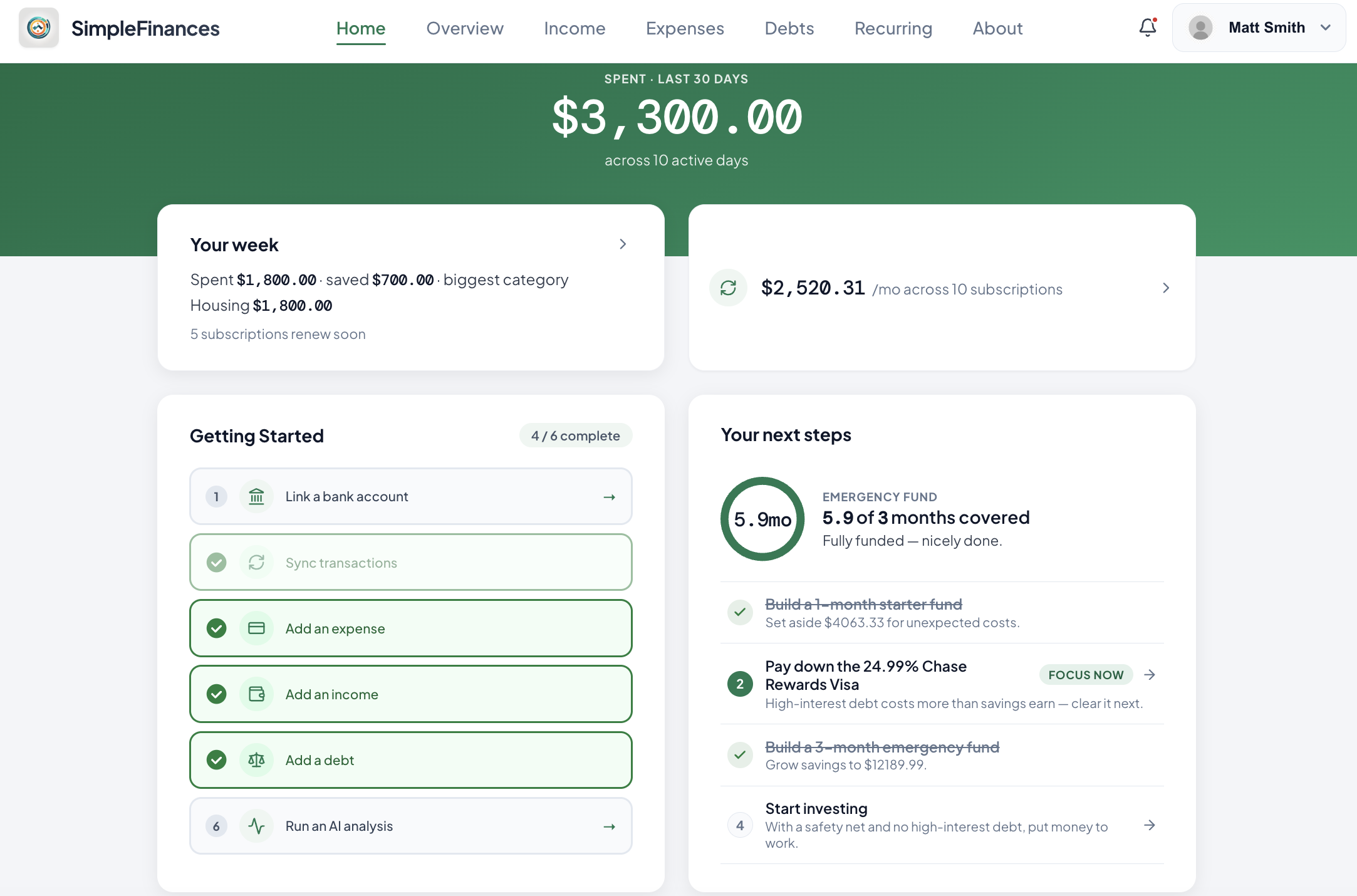
SimpleFinances was built around the one Mint feature people miss most: seeing every transaction organized by category, and knowing the next step to take. When you connect an account through Plaid (a read-only link, so your login stays with your bank and nothing can move money), your purchases are sorted automatically. You get the monthly "where did it all go" answer Mint used to give you, plus a subscription finder that surfaces the recurring charges quietly draining your account. On top of that sits a financial health score, a net-worth timeline, and a cash-flow calendar, so you see the whole picture rather than a wall of charts. And there is no data cliff and no subscription clock: the Full Financial Review is one payment of $49.99, nothing renews from it, and the report is yours to keep, so you can rebuild the picture you lost when Mint closed without a countdown forcing a decision. Unlike Mint, SimpleFinances is paid for by the people who use it, not by selling your data or showing you ads.
How much does SimpleFinances cost?
The Full Financial Review is $49.99, one time. One payment, no subscription. You link every account read-only (banks, cards, loans, investments; if a bank will not connect, drag and drop a statement), get one complete financial review with every recurring charge found and totaled, and 7 days of full Premium access. The review report is yours to keep. Nothing renews automatically from the $49.99; if you want ongoing tracking afterwards, that is a separate choice you make later, never before. What we deliberately do not do is run a free-trial countdown that auto-charges you, or a "pay what you think is fair" prompt that nudges the number up. It is backed by a 30-day money-back guarantee: full refund, no questions asked. That is the point: after Mint disappeared, the last thing former users want is another subscription.
What's the next step after Mint?
It's easy to see if SimpleFinances fits. Create an account, connect one account through Plaid or add transactions manually, and within a few minutes you'll see your spending sorted by category and a first pass at the subscriptions you're paying for. If it answers the question Mint used to answer (where did my money actually go), you'll know right away. Start with the free five-question money audit. When you want the full picture, the Full Financial Review is one payment of $49.99, not another subscription: every account linked read-only, every recurring charge found and totaled, 7 days of full Premium access, and a report that is yours to keep, with a 30-day money-back guarantee. Former Mint users lost their history once already; the goal here is a tool you can settle into and keep.
See where your money actually goes
One payment of $49.99 for a Full Financial Review, no subscription, no trial countdown, and no data selling. Rebuild the clarity Mint used to give you in a few minutes.
Start my free money auditSources
- Monarch, "Pricing": monarch.com/pricing. Source of the Core price ($14.99/mo or $99.99/yr), the Plus price ($199.99/yr, annual only), and the 7-day trial with a payment method required. Checked 2026-09-28.
- Rocket Money, "Rocket Money Pricing: What's Free vs. What's Premium vs Premium+?" (January 19, 2026): rocketmoney.com. Source of the free tier, the "pay what you think is fair" Premium range ($7–$14/mo), the Premium+ price ($15/mo), and the 35–60% bill-negotiation fee. Checked 2026-09-28.
- Rocket Money Help Center, "How much does Rocket Money cost?": help.rocketmoney.com. Source of the 7-day Premium free trial. Checked 2026-09-28.
- Intuit Credit Karma, "How does Credit Karma work?": creditkarma.com. Source of Credit Karma being free to use and paid a commission when members are approved for recommended products. Checked 2026-09-28.
- Intuit Credit Karma, "Intuit Credit Karma welcomes all Minters!" (press release, October 31, 2023): creditkarma.com. Source of Mint users being invited to move to Credit Karma. Checked 2026-09-28.
- CNBC Select, "Mint is gone" alternatives roundup (updated May 13, 2026): cnbc.com. Source of the March 23, 2024 shutdown date; Intuit's own mint.intuit.com now says only that "Mint has been reimagined on Credit Karma." Checked 2026-09-28.