
Money Guide
Budgeting Tips: 15 Ways to Save Money Each Month
Not "make coffee at home." Fifteen concrete budgeting tips with real dollar figures: how to see where your money actually goes, cut the charges leaking out quietly, and automate the saving so it keeps happening every month without willpower.
Most budgeting advice fails for the same reason: it's a list of things to stop doing, powered entirely by willpower, and willpower runs out around the 18th of the month. The tips below are built the other way around. A few are one-time moves you make once and bank all year; a few change a default so the saving happens whether you think about it or not; the rest are small habits that take minutes. Every one comes with a number, because "spend less" is not a plan and "save $75 a month by switching two takeout orders to pickup" is.
It helps to know the backdrop. The U.S. personal saving rate sat around 4.7% of disposable income in late 2025, according to the U.S. Bureau of Economic Analysis, and a Bankrate survey found that only 30% could pay a $1,000 surprise bill from savings. The gap between those two numbers and a stable financial life isn't usually a giant sacrifice. It's a handful of the moves below, done consistently.
First, see where your money actually goes
You cannot cut a number you've never measured. Before you cancel anything or set a limit, spend a few minutes getting an honest picture of the last three months. These four tips are about measurement; do them first, because every later cut depends on knowing which numbers are actually big.
Measure 90 days before you cut a single dollar
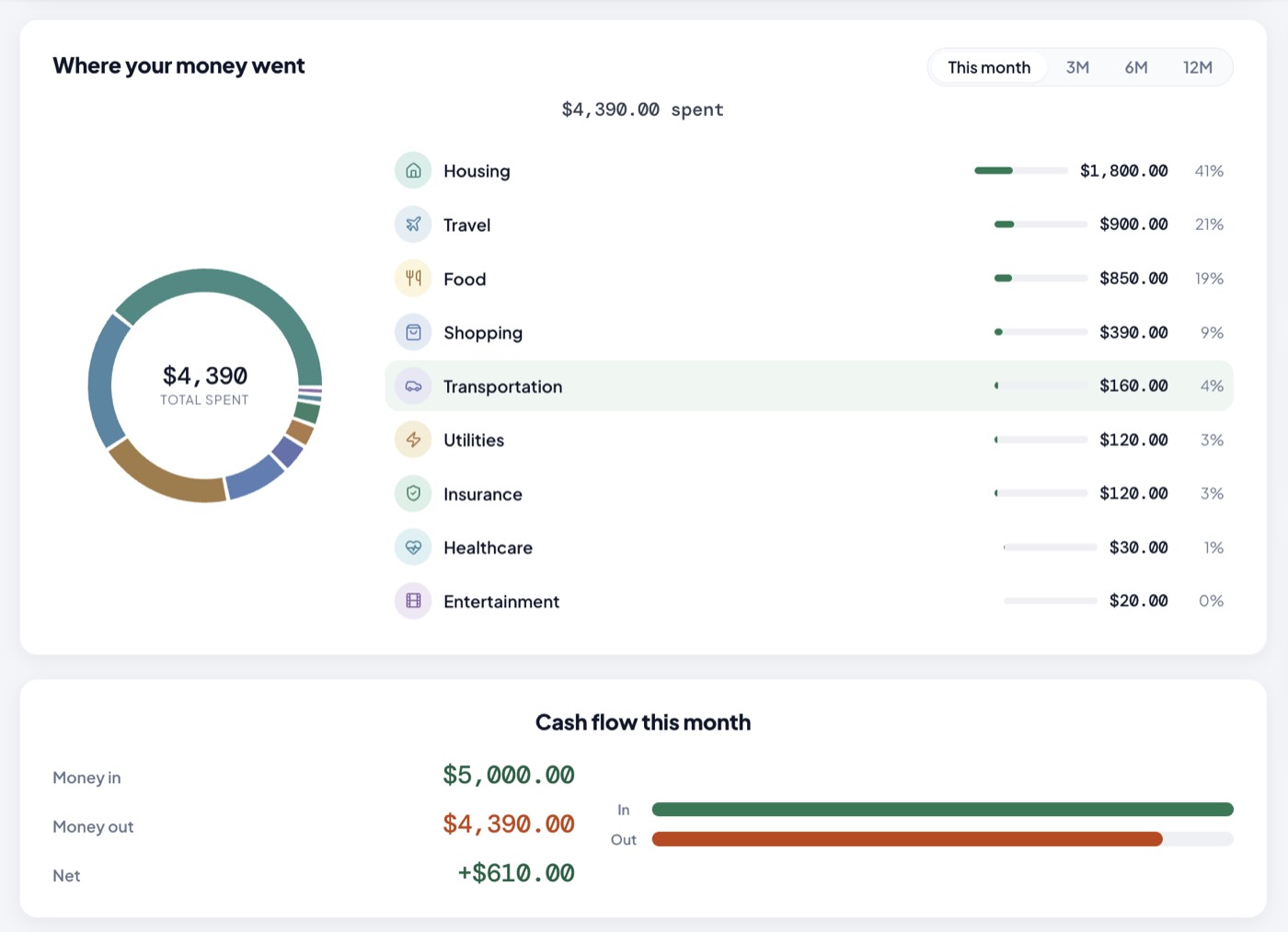
One month lies. It might be the month a $220 annual insurance bill hit, or the month you barely bought groceries. Pull the last three months and average them; that smooths out the one-offs and shows your true monthly baseline. If sorting three months of transactions by hand sounds like the reason you've never done it, this is where SimpleFinances earns its keep: it connects to your accounts, categorizes every transaction automatically, and its spending review shows the 90-day picture for each category without you touching a spreadsheet.
Rank categories by size, then attack the top three
Trimming your biggest categories 15% beats eliminating your smallest ones entirely. A $650 monthly grocery bill cut by 15% saves about $98 a month; skipping a $5 coffee saves $5. Sort your spending highest to lowest and work top-down: usually housing, food, transport, and shopping. The order matters because attention is limited, and it should go where the dollars are.
Split fixed costs from variable ones: they need different tools
Fixed costs (rent, insurance, loan payments, phone) you renegotiate once and the savings repeat every month with no ongoing effort. Variable costs (groceries, dining, shopping) you manage weekly with limits and attention. Label each category as one or the other. Most people waste effort white-knuckling their variable spending while never once calling to lower a fixed bill, which is the lazier, more durable win.
Shrink your "miscellaneous" line below 10%
If more than roughly 10% of your spending lands in "miscellaneous" or "uncategorized," you're effectively flying blind on that chunk, and blind money is where the quiet leaks live. Go through the misc pile and give each charge a real category until the bucket drops under 10% of the total. Automatic categorization does most of this for you, but the manual pass on what's left almost always surfaces a charge or two you'd forgotten was even yours.
Cut the silent leaks
Silent leaks are charges small enough that no single one triggers a second look, but which add up to real money over a year. They don't require you to give anything up; mostly they ask you to stop overpaying for things you're already getting. This is the fastest cash most people find.
List every recurring charge: you're underestimating
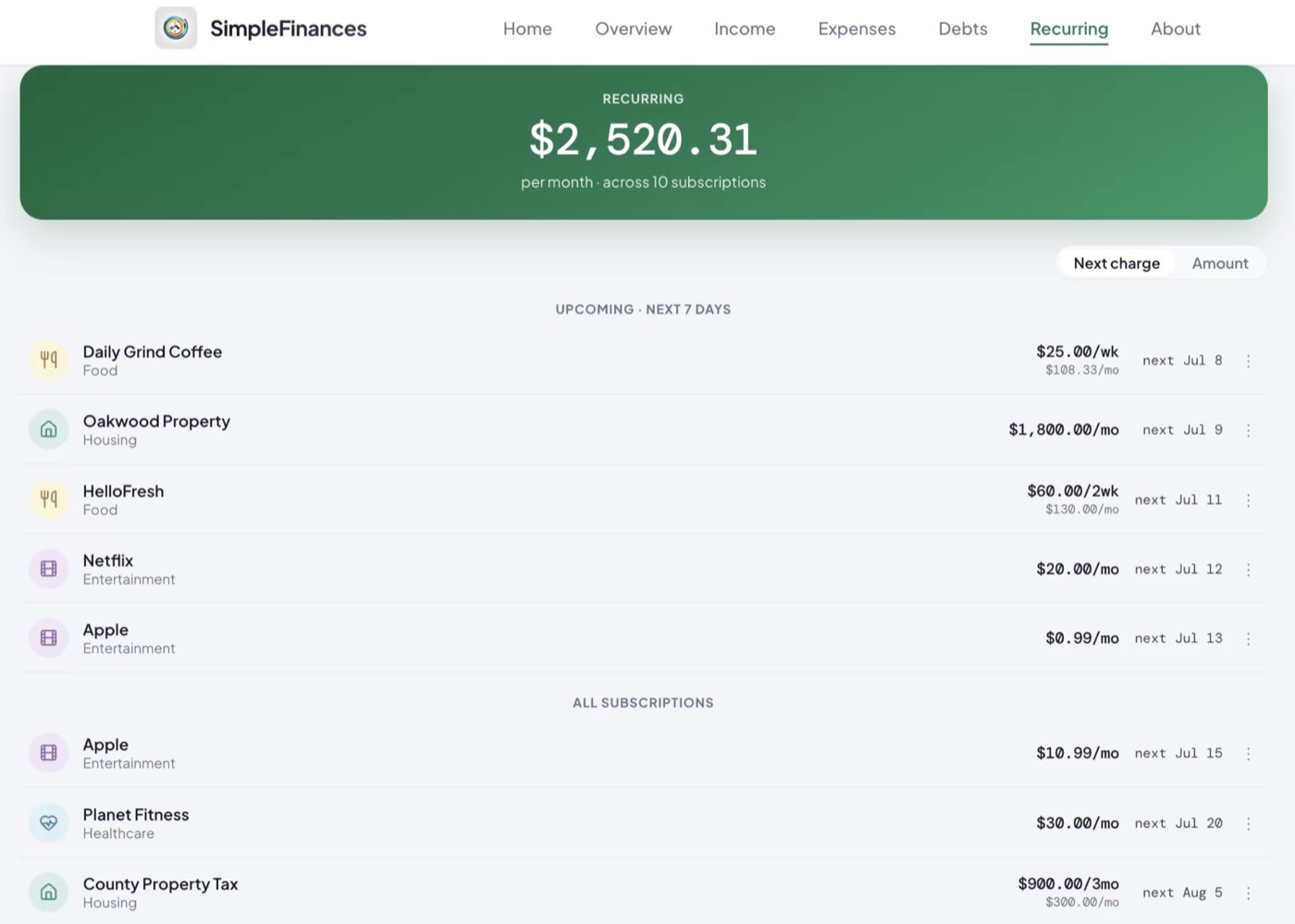
In a 2022 survey of 1,000 consumers, C+R Research found people guessed they spent about $86 a month on subscriptions, then added up their actual services and landed at $219, a $133 monthly gap, and 42% admitted paying for something they'd stopped using. Write down every recurring charge with its amount and billing date. Faster: the SimpleFinances subscription finder reads your transaction history and surfaces every charge that repeats, including the annual renewals a one-month glance misses. Our full guide to finding forgotten subscriptions and the subscription tracker walk through it, and most people turn up charges they'd forgotten about.
Kill the "convenience tax" on food delivery
Ordering delivery costs about 79.5% more than picking up the same meal: an extra $9.30 per order once you total menu markups, service fees, delivery fees, and tip, according to LendingTree research. You don't have to stop ordering. Just switch your two most-frequent orders to pickup. Order delivery twice a week and that single swap is roughly $75 a month, near $900 a year, for the same food.
Downgrade instead of cancel
Canceling a service you'll miss doesn't last; you re-subscribe in a month. Downgrading does. Ad-supported streaming tiers run around $7–8 versus $16–23 for ad-free, the same catalog for roughly $10 less each. Do the same with phone data (most people pay for "unlimited" and use a fraction) and cloud storage tiers. Three downgrades at $10 apiece is $360 a year, and you keep everything you actually use.
Re-shop insurance and internet every 12 months
Loyalty is penalized, not rewarded: auto insurers and internet providers quietly raise rates on customers who never leave, while reserving the best pricing for new sign-ups and anyone who calls to cancel. Put a yearly calendar reminder to get two competing quotes and call your current provider's retention line. Even a $25/month reduction is $300 a year for one phone call you make once.
A pattern worth noticing: tips 5 through 8 don't ask you to live with less. You keep your shows, your food, your coverage. You just stop overpaying for them. That's why leak-cutting sticks where "spend less on fun" never does.
See your real numbers, free
Tips 1–8 all start with one thing: knowing where your money actually goes. Connect an account or add transactions by hand, and SimpleFinances categorizes your spending, finds recurring charges, and gives you a financial health score, so you're cutting from facts, not guesses. Prefer to shop around first? Pick one of the free budgeting apps and compare what each free tier includes.
No subscription: the Full Financial Review is $49.99, one time, with 7 days of full Premium access and a 30-day money-back guarantee.
Make saving automatic
The single biggest predictor of whether you save is not how much you earn; it's whether saving requires a decision each month. Remove the decision and the money accumulates on its own. These three tips are about design, not discipline.
Move savings the day after payday, not the day before the next one
Whatever's "left over" at the end of the month is almost always $0; spending expands to fill the balance. Flip the order: schedule an automatic transfer to savings for the day after each paycheck lands. Pay yourself first, treat it like a bill that's already due, and budget the rest. Even $50 per paycheck, automated, is $1,300 a year you never had to feel yourself saving.
Split the deposit at the source
Better than an automatic transfer is never seeing the money in checking at all. Most payroll systems let you split your direct deposit: route a fixed dollar amount straight to a savings account and the rest to checking. Money that never appears in your spending account doesn't get spent, because it never feels available. Set it as a flat number, not a percentage, so it doesn't shrink on a light paycheck.
Keep the emergency fund at a different bank
An emergency fund at the same bank as your checking is one tap away at 11pm, which is exactly when it gets raided for something that isn't an emergency. Park it at a separate institution (a high-yield online savings account works, and earns more interest besides). The 1–3 day transfer time is just enough friction to stop the impulse, while still being fully accessible when a real emergency comes.
Keep it going, month after month
A budget isn't a one-time cleanup; it's a habit that stays honest as life changes. New trials convert to paid, prices creep at renewal, and last month's cancelled service gets replaced by two new ones. These four tips keep the system from quietly drifting back.
Give every dollar a job (zero-based budgeting)
At the start of each month, assign your expected income to categories (bills, groceries, fun, savings, debt) until you have $0 unassigned. This is zero-based budgeting, and the point isn't spending to zero; it's that money without a job drifts into spending. When your leftover $300 is pre-assigned to "extra debt payment" or "vacation fund," it stops evaporating into unremembered purchases.
Do a 15-minute money check-in every week
Catching that you've overspent groceries on day 10 lets you course-correct for the rest of the month. Finding it on day 30 is just regret. Once a week, spend fifteen minutes looking at what you've spent against your category limits. A weekly rhythm is short enough to fix and frequent enough to matter. A cash-flow calendar that maps upcoming bills against income makes the check-in a glance rather than a chore.
Use a 30-day list for any non-essential over $50
For any want above $50, don't buy it. Add it to a dated list and wait 30 days. When the month is up, buy only what still feels worth it. Most urges are gone by then, and the ones that survive are things you actually wanted rather than things a checkout page wanted you to want. It's a filter that costs nothing and quietly deletes a chunk of impulse spending.
Track net worth monthly, not just spending
Spending tells you about this month; net worth (everything you own minus everything you owe) tells you whether the whole system is working. Check it once a month. A number that climbs even slowly means the tips above are compounding. SimpleFinances plots a net-worth timeline and a financial health score automatically as your balances update, so the one metric that actually answers "am I getting ahead?" is always in front of you.
What's the best way to save money each month?
The best way to save money each month is to automate a fixed transfer to savings the day after you get paid, then make your cuts in your largest spending categories rather than your smallest. Saving whatever is "left over" rarely works, because there's usually nothing left; paying yourself first (routing a set amount, even $50 or $200, to a separate account before you can spend it) turns saving into a bill you've already paid. Pair that with an honest look at where your money goes: review the last 90 days, rank your categories biggest to smallest, and trim the top three. A 15% cut to a $600 grocery bill saves far more than skipping coffee. Then protect the result by canceling forgotten subscriptions and re-shopping recurring bills once a year. Automation makes saving happen; category-level cuts make it add up.
A worked example: budgeting a $4,000 monthly take-home
Frameworks make this concrete. The best-known is the 50/30/20 rule, popularized by U.S. Senator Elizabeth Warren and her daughter Amelia Warren Tyagi in their 2005 book All Your Worth: The Ultimate Lifetime Money Plan: split after-tax income into 50% needs, 30% wants, and 20% savings and debt payoff. It's a starting point, not a law, but it turns abstract advice into target numbers. Here's how it looks on a $4,000 monthly take-home:
| Bucket | Example line items | Amount |
|---|---|---|
| Needs: 50% | Rent $1,300 · utilities $200 · groceries $350 · insurance & transport $150 | $2,000 |
| Wants: 30% | Dining & delivery $350 · subscriptions $80 · shopping & fun $500 · travel fund $270 | $1,200 |
| Save & repay: 20% | Emergency fund $300 · retirement $300 · extra debt payment $200 | $800 |
| Total | Every dollar assigned | $4,000 |
Notice how the earlier tips plug straight in. Tip 6 (switch two delivery orders to pickup) frees roughly $75 from the $350 dining line. Tips 5 and 7 (cancel forgotten subscriptions, downgrade the rest) can halve that $80 subscriptions line. Redirect both to the "save & repay" bucket and you've pushed your savings rate from 20% toward 23% without touching your rent or your fun money. If your needs already run past 50% (common with today's rents), don't force the split; use it as a direction to move toward, and let the leak-cutting close the gap.
What are the most common budgeting mistakes to avoid?
Three mistakes sink most budgets. The first is budgeting from memory instead of data: guessing what you spend, setting limits you've already blown, and giving up when reality doesn't match. Start from your actual last 90 days (tip 1). The second is cutting the small stuff first: the well-publicized latte gets the blame while a forgotten $60 in subscriptions and an $80-a-month delivery habit sail through untouched. Rank by size (tip 2). The third is relying on willpower to save: leaving it to month-end discipline that never survives contact with a normal month. Automate it (tips 9–11). Avoid those three and the rest of budgeting is mostly maintenance: a weekly glance and a monthly reset.
None of these fifteen tips is dramatic on its own. That's the point. A $75 delivery swap, a $60 subscription cleanup, a $25 insurance re-shop, and an automated $100 transfer don't feel like sacrifice, but stacked together they're over $3,000 a year, moving quietly in your direction every month. Budgeting that works isn't about a heroic month of restraint. It's a handful of good defaults you set once and a fifteen-minute habit you keep.
Put these tips on autopilot
SimpleFinances does the measuring for you: automatic categorization, a subscription finder, spending review, a cash-flow calendar, and a financial health score, all in one place. See your real numbers and watch them move as the tips above compound.
One-time Full Financial Review: $49.99. One payment, no subscription, 30-day money-back guarantee.
Sources
- Elizabeth Warren & Amelia Warren Tyagi, All Your Worth: The Ultimate Lifetime Money Plan (Free Press, 2005): origin of the 50/30/20 budgeting rule.
- C+R Research, "Subscription Service Statistics and Costs" (survey of 1,000 U.S. consumers, 2022): crresearch.com. Source of the $86 vs. $219 subscription spend ($133 gap) and 42% forgotten-subscription figures.
- Bankrate Emergency Savings Report (survey conducted Dec 2024): bankrate.com. Source of the 30% who could pay a $1,000 surprise bill from savings.
- U.S. Bureau of Economic Analysis, "Personal Saving Rate": bea.gov. Source of the ~4.7% U.S. personal saving rate in late 2025.
- LendingTree, study on food-delivery costs vs. pickup: lendingtree.com. Source of the ~79.5% delivery markup and ~$9.30 per-order figure.