 SimpleFinances
What does YNAB do well?
Credit where it's due: YNAB (You Need A Budget) has one of the most loyal user bases in personal finance, and it earns that loyalty. Its method is built on four rules, starting with the famous "give every dollar a job." This is zero-based budgeting: before you spend anything, you assign every dollar you have to a specific category, so your budget always balances to zero and nothing is unaccounted for. The other rules ask you to plan for irregular expenses, roll with overspending by moving money between categories, and gradually "age your money" so you're spending last month's income, not this week's. It's a genuine system for changing behavior, not just a tracker. YNAB runs on the web, iOS, Android, and even Apple Watch, syncing in real time, and it offers a generous 34-day free trial with no credit card required, among the longest trials in the category. If you want a disciplined framework that actively reshapes how you spend, YNAB is a proven, purpose-built choice.
How is SimpleFinances different from YNAB?
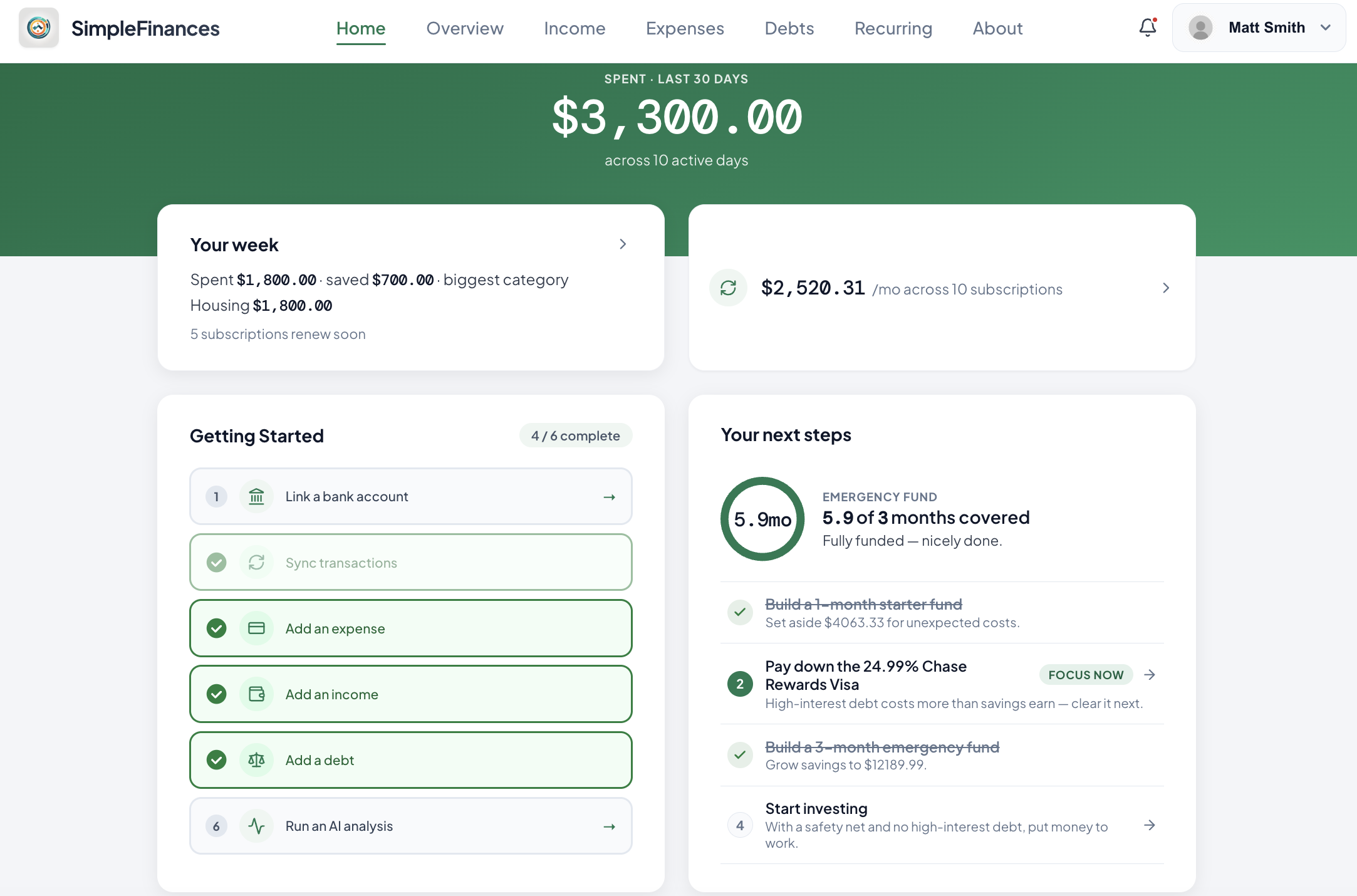
SimpleFinances is built for people who want the answer without the homework. Where YNAB asks you to sit down and assign every dollar a job (a habit that works beautifully for some and quietly falls apart for others), SimpleFinances categorizes your transactions automatically and shows you where your money actually went. On top of that sit a financial health score, a net-worth timeline, and a cash-flow calendar, so you see the whole picture at a glance rather than maintaining a category-by-category plan. It also detects recurring charges and subscriptions, surfacing the quiet leaks in your spending. The philosophy is different on purpose: YNAB is proactive and demands regular engagement to deliver its value; SimpleFinances is largely passive: you connect an account and the insight shows up, whether or not you log in every day.
Choose YNAB if…
- You want a strict, proactive budgeting method with real rules to follow.
- You're willing to assign every dollar and check in regularly.
- Changing your spending behavior is the goal, not just seeing it.
- A native mobile app and Apple Watch support matter to you.
Choose SimpleFinances if…
- You want to see where your money went automatically, without daily upkeep.
- You value the full picture: categories, net worth, cash flow, health score.
- You'd rather not build and maintain a zero-based budget by hand.
- You're happy in a fast web app that works on any device.
What about other YNAB alternatives: Monarch, Simplifi, or PocketSmith?
If you're shopping for a YNAB alternative, you've probably also seen Monarch, Simplifi, and PocketSmith come up. They're all solid, well-built trackers with loyal users, and any of them will give you a cleaner view of your finances than a spreadsheet. We won't pretend to quote their exact prices or feature lists here (those change often, and you should confirm them directly before deciding), but the honest positioning is simple: like YNAB, most of these tools still expect you to do some categorizing, tagging, or planning to get their full value. SimpleFinances' angle is different on purpose. It categorizes your spending automatically and then points you at the next step (the subscription you forgot, the category creeping up, the health score that just moved), all for one payment, not another subscription. If you want a hands-on planner, any of the above may suit you well; if you want the answer without the upkeep, that's the specific gap SimpleFinances is built to fill.
How do SimpleFinances and YNAB compare on price?
YNAB keeps pricing simple with a single plan: $14.99 a month, or $109 a year (about $9.08/month), and everyone gets the same full product. There's no ongoing free tier: once the 34-day trial ends, access requires a subscription (students can get a longer free stretch with a valid school email). SimpleFinances is not a subscription at all: the Full Financial Review is $49.99, one time. One payment, no subscription. You link every account read-only, get one complete review with every recurring charge found and totaled, 7 days of full Premium access, and a report that is yours to keep, with a 30-day money-back guarantee. SimpleFinances doesn't run a free trial because there is nothing for it to convert into; YNAB doesn't keep a free tier. The real difference isn't the number. It's whether you're paying every month for a method you'll work every day or paying once for automatic insight that shows up on its own.
SimpleFinances vs YNAB: feature comparison
| SimpleFinances | YNAB | |
|---|---|---|
| Starting price | Free money audit; $49.99 one-time review, no subscription | $14.99/mo (single plan) |
| Price to see your full picture | $49.99 one time, no subscription | $14.99/mo or $109/yr |
| Free trial | No trial needed: one payment, 30-day money-back guarantee | 34 days, no card required |
| Ongoing free tier | No | No |
| Budgeting approach | Automatic: see where money went | Manual zero-based: assign every dollar |
| Tells you what to fix first | Yes Full review with next steps | A budget you build and maintain |
| Automatic categorization | Yes | Import, then you assign by rule |
| Recurring & subscription finder | Yes Included in the review | No dedicated finder |
| Financial health score | Yes | No |
| Net worth & cash-flow calendar | Yes | Net worth yes; no cash-flow calendar |
| Daily engagement expected | No | Yes, by design |
| Bank connections | Plaid, read-only + manual | Linked import + manual entry |
| Platform | Web: works on any device, nothing to download | iOS, Android, web, Apple Watch |
The honest summary: YNAB is the better pick if you want a rigorous budgeting method and you'll put in the daily work to run it. That discipline is exactly why its fans stay for years. SimpleFinances is the better pick if you want a full review of your money and what to fix first: a one-time $49.99 read of every account, with the report yours to keep. It is built for people who want to make changes, not another dashboard to check. No hand-built budget to maintain.
Who should choose YNAB over SimpleFinances?
Being fair means being clear about who YNAB is for. If your problem is behavioral (you make enough but it keeps slipping away, and you want a system that forces intention onto every dollar), YNAB's method genuinely works, and its community and teaching materials are excellent. People who stick with the four rules often describe it as the thing that finally changed their relationship with money. That payoff comes from engagement: YNAB rewards the person who reconciles regularly, moves money between categories when plans change, and treats budgeting as an active weekly ritual. If that sounds like a habit you'll keep, YNAB is worth the price. SimpleFinances is the better fit when the honest answer is that you won't keep up a manual budget: you just want to know where the money went, whether your net worth is climbing, and which subscriptions are quietly draining your account, without logging in to assign dollars every few days.
How much does SimpleFinances cost?
The Full Financial Review is $49.99, one time. One payment, no subscription. You link every account read-only (banks, cards, loans, investments; if a bank will not connect, drag and drop a statement), get one complete financial review with every recurring charge found and totaled, and 7 days of full Premium access: net worth, spending by category, budgets, bill and balance alerts, cash-flow forecasting, tax-ready reports and CSV export, and the financial health score working together. The review report is yours to keep. Nothing renews automatically from the $49.99; if you want ongoing tracking afterwards, that is a separate choice you make later, never before. There's no "pay what you think is fair" slider and no free-trial countdown that quietly converts to a charge. It is backed by a 30-day money-back guarantee: full refund, no questions asked.
Can you switch from YNAB to SimpleFinances?
Yes, and it's a quick move if you've decided the hands-on method isn't sticking for you. Create an account, connect one account through Plaid (a read-only link, so your login stays with your bank and nothing can move money) or add transactions manually, and SimpleFinances sorts your spending into categories automatically. Within a few minutes you'll see the "where did it all go" answer, a first pass at your recurring charges, and your net worth over time, with no category-by-category budget to rebuild. You lose YNAB's proactive assignment discipline in the trade, which is the whole point: SimpleFinances is for the person who'd rather have the insight handed to them than construct it. If you're not sure which camp you're in, YNAB's 34-day trial and SimpleFinances' one-time $49.99 Full Financial Review (one payment, no subscription, 30-day money-back guarantee) both make it cheap to find out.
See where your money actually goes
Automatic categorization, a financial health score, net worth over time, and your subscriptions surfaced, for one payment of $49.99, no subscription, and no budget to build by hand.
Start my free money auditSources
- YNAB, "Pricing": ynab.com/pricing. Source of the $14.99 monthly and $109 annual prices and the 34-day free trial with no credit card required. Checked 2026-09-28.