 SimpleFinances
How much does EveryDollar cost?
The free version is free forever, but it's manual-entry only. Every coffee, every gas fill-up, every Amazon order: you type it in yourself, because bank connections are a premium feature. EveryDollar Premium adds automatic bank sync, paycheck and bill-date planning, custom reports, and access to coaching, at $17.99 a month or $79.99 a year (about $6.67/month), after a 14-day free trial that converts to a charge. For comparison, SimpleFinances does not sell a subscription for this at all: the one-time $49.99 Full Financial Review links every account read-only, includes bank connections and automatic categorization, finds and totals every recurring charge, and gives you 7 days of full Premium access, with nothing renewing afterwards and no trial clock. Worth saying plainly: EveryDollar Premium is an ongoing charge and the SimpleFinances review is one payment, so they are different shapes of product. The difference is what each dollar buys, which the rest of this page covers.
Is EveryDollar Plus the same as Premium?
Premium is the paid tier you can buy today, so if you are looking up what EveryDollar Plus costs, the Premium prices above apply. Ramsey Solutions' EveryDollar page lists only two versions, Free and Premium, and does not mention a Plus tier (checked 2026-09-28); "EveryDollar Plus" is a name many people still search for.
What does EveryDollar do well?
EveryDollar is the official budgeting app of Ramsey Solutions, and it's the cleanest implementation of zero-based budgeting you can get: before the month starts, you give every dollar of expected income a job (rent, groceries, debt payoff, savings) until income minus assignments equals zero. That planning discipline is the whole Ramsey philosophy in app form, and it genuinely works for people working the Baby Steps out of debt. The free tier is real (unlimited budget categories, no time limit), it runs on iPhone, Android, and the web, and the paid tier adds thoughtful planning features like paycheck-date scheduling so your budget matches when money actually arrives. If you're following the Ramsey plan and you want its app, EveryDollar is exactly that.
Is the free version of EveryDollar enough?
Honestly: it can be, if you'll actually do the typing. In the zero-based method, manually entering each transaction is partly the point, not a missing feature. The friction is the feature: typing in a $6.40 coffee makes you feel the purchase, and Ramsey fans will tell you that awareness is where the behavior change comes from. If that's you, the free tier is a legitimately good tool and you should use it.
The catch is what happens in practice: most people stop entering transactions after a few weeks, and a budget that isn't fed becomes fiction: the app says you have grocery money left because it doesn't know about Tuesday. That's the honest test for "is free enough": not whether the features are sufficient, but whether you'll still be doing data entry in March. If the answer is no, you need bank sync, which means paying for EveryDollar Premium, or using a tool where the connection is included from the bottom tier.
Zero-based vs automatic: the real difference
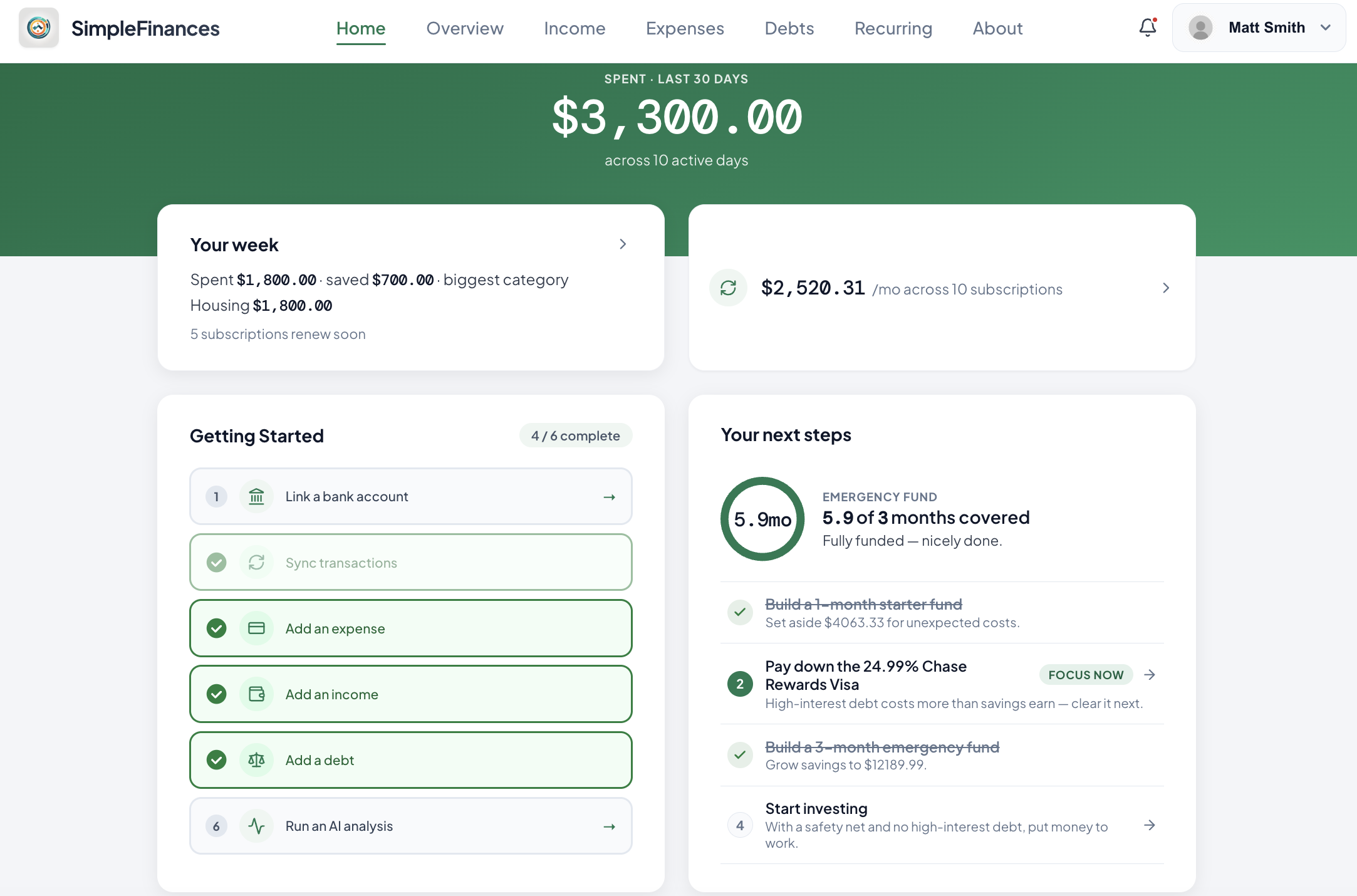
This comparison is less about features than about method. Zero-based budgeting is forward-looking: you plan the month before it happens and steer to the plan. It builds real intentionality, and it demands real upkeep: assigning dollars, recategorizing, adjusting when life ignores the plan. Automatic budgeting, the SimpleFinances approach, is reality-first: connect your accounts, and the app shows you where the money actually went, categorized without your help, with the recurring charges you forgot about surfaced alongside. One is a workout program; the other is a fitness tracker. Neither is wrong. But the best method is the one you'll still be using in six months, and if the data-entry habit has failed you before, that's evidence worth trusting about yourself.
Choose EveryDollar if…
- You're working the Ramsey Baby Steps and want the official tool.
- Zero-based planning discipline is what you're after, and you'll maintain it.
- You'll genuinely enter transactions by hand (free), or you want an ongoing subscription with bank sync.
- Coaching access matters to you.
Choose SimpleFinances if…
- You want bank sync and automatic categorization in one payment, not another subscription.
- You'd rather see where money actually went than maintain a plan.
- Forgotten subscriptions, a health score, and net worth matter to you.
- You never want a 14-day trial clock that converts to a charge.
SimpleFinances vs EveryDollar: feature comparison
| SimpleFinances | EveryDollar | |
|---|---|---|
| Free tier | No: one-time $49.99 review, no subscription | Yes Manual entry only |
| Bank sync & auto-categorization | Yes Included | Premium only ($17.99/mo or $79.99/yr) |
| Price to see your full picture | $49.99 one time, no subscription | $17.99/mo |
| Annual price (full product) | None required: one $49.99 payment | $79.99/yr |
| Free trial required? | No trial needed: one payment, 30-day money-back guarantee | 14-day trial, then charges |
| Method | Automatic: shows where money went | Zero-based: plan you maintain |
| Tells you what to fix first | Yes Full review with next steps | A dashboard you set up and maintain |
| Subscription finder | Yes Included in the review | No |
| Financial health score | Yes | No |
| Net worth & cash-flow calendar | Yes | Partial: paycheck & bill planning |
| Coaching access | No | Yes (Premium) |
| Platform | Web: works on any device, nothing to download | iOS, Android, web |
The honest summary: if you're committed to the Ramsey method (or you'll truly do manual entry), EveryDollar is the right tool. If what you actually want is to be told where your money goes and what to fix first, SimpleFinances is the better pick: a one-time $49.99 Full Financial Review of every account, no subscription, with the report yours to keep. It is built for people who want to make changes, not another dashboard to check.
How much does SimpleFinances cost?
The Full Financial Review is $49.99, one time. One payment, no subscription. You link every account (banks, cards, loans, investments) read-only, and if a bank will not connect you can drag and drop a statement. It includes the parts EveryDollar paywalls (bank connections and automatic categorization), one complete financial review with every recurring charge found and totaled, 7 days of full Premium access (subscription finder, financial health score, net-worth timeline, and cash-flow calendar), and a report that is yours to keep. It carries a 30-day money-back guarantee: full refund, no questions asked. Nothing renews automatically from the $49.99; if you want ongoing tracking afterwards, that is a separate choice you make later, never before. No ads, no 14-day countdown: you know the price before you start, you pay it once, and nothing renews after two weeks.
See your money without the homework
Every transaction categorized automatically, forgotten subscriptions surfaced, and a health score, in one Full Financial Review for $49.99 one time. Bank sync included, no subscription, no trial countdown. Start with the free five-question audit.
Start my free money auditSources
- Ramsey Solutions, "EveryDollar Budget App": ramseysolutions.com/money/everydollar. Source of the Free and Premium versions, the Premium price ($17.99/mo or $79.99/yr, about $6.67/mo billed annually), the 14-day free trial, and bank connections being Premium only. Checked 2026-09-28.