 SimpleFinances
Does Credit Karma have a budgeting tool?
Partly. Credit Karma lets you connect accounts and see your transactions, some spending insights, and a net worth view, features Intuit expanded as it moved Mint users over to Credit Karma. It is not a budgeting app, though: it sorts spending into categories but has no budget you plan against and no dedicated subscription finder, because the product is built around your credit score and the card and loan offers that fund it.
What does Credit Karma do well?
Credit where it's due, in this case literally. Credit Karma is genuinely good at what it was built for: free credit-score access and monitoring, credit-report tracking, and credit-building tools. It also offers Credit Karma Money checking and savings accounts with no monthly fees, and it ships polished native apps for iOS and Android. All of that costs you nothing, and for the specific job of keeping an eye on your credit file (watching your score move, catching new accounts or hard inquiries, understanding what's helping and hurting), it's one of the best free tools available.
Why do people look for a Credit Karma alternative?
Because at some point they want to manage their money, not just their credit score, and that's not the job Credit Karma was built for. It has money-tracking features, especially since Intuit shut down Mint in March 2024 and moved its users over: you can connect accounts, see transactions, and get some spending insights. But category-based budgeting (every purchase grouped so you can see what groceries, dining, and subscriptions actually cost you this month) is not the product's focus, and there's no tool for hunting down recurring charges you forgot about.
There's also the business model. Credit Karma is free because banks and lenders pay it a commission when you are approved for the credit cards and loans it recommends. That's a fair trade for a credit-monitoring tool, and the company is upfront about it. But it means the interface is built around offers, and the app's incentive is to show you new financial products, not to help you spend less. When the thing you want is a quiet, honest picture of your own money, an ad-funded product pulls in the opposite direction.
Credit Karma alternatives, by what you need
"Credit Karma alternative" means two different things, depending on what you use Credit Karma for. Be clear about which one you are after before you switch anything.
If you want your credit score and credit monitoring
Stay with a free tool built for that job. Credit Karma itself is one of the best. Experian, one of the three credit bureaus, runs its own free credit-score service, and many credit card issuers show cardholders a free credit score in their app or statement. None of the budgeting apps below, SimpleFinances included, shows your credit score, so they are not the right pick here.
If you want a budgeting app
- Monarch Money: a paid, polished budgeting dashboard with budgets, rules, goals, and investment views. Best for people who enjoy configuring their setup. How it compares to Credit Karma is covered below.
- YNAB: hands-on, give-every-dollar-a-job budgeting. Best for people who want to plan each dollar before they spend it. See our YNAB comparison.
- Rocket Money: strongest at finding and cancelling subscriptions and negotiating bills. See our Rocket Money comparison.
- SimpleFinances: automatic categorization, a subscription and recurring-charge finder, and a one-time Full Financial Review that tells you what to fix first. Best for seeing where your money goes without another subscription. Compared with Credit Karma in detail below.
How does Monarch Money compare to Credit Karma for budgeting?
Monarch Money is a paid budgeting app; Credit Karma is a free credit-monitoring tool with basic spending tracking. Monarch has no free tier, and in return you get budgets, rules, goals, and investment views to configure. Credit Karma charges nothing because banks and lenders pay it when members are approved for the cards and loans it recommends. Use Credit Karma for your score and a budgeting app for your spending. Our SimpleFinances vs Monarch comparison covers Monarch's current pricing and features in detail.
How is SimpleFinances different from Credit Karma?
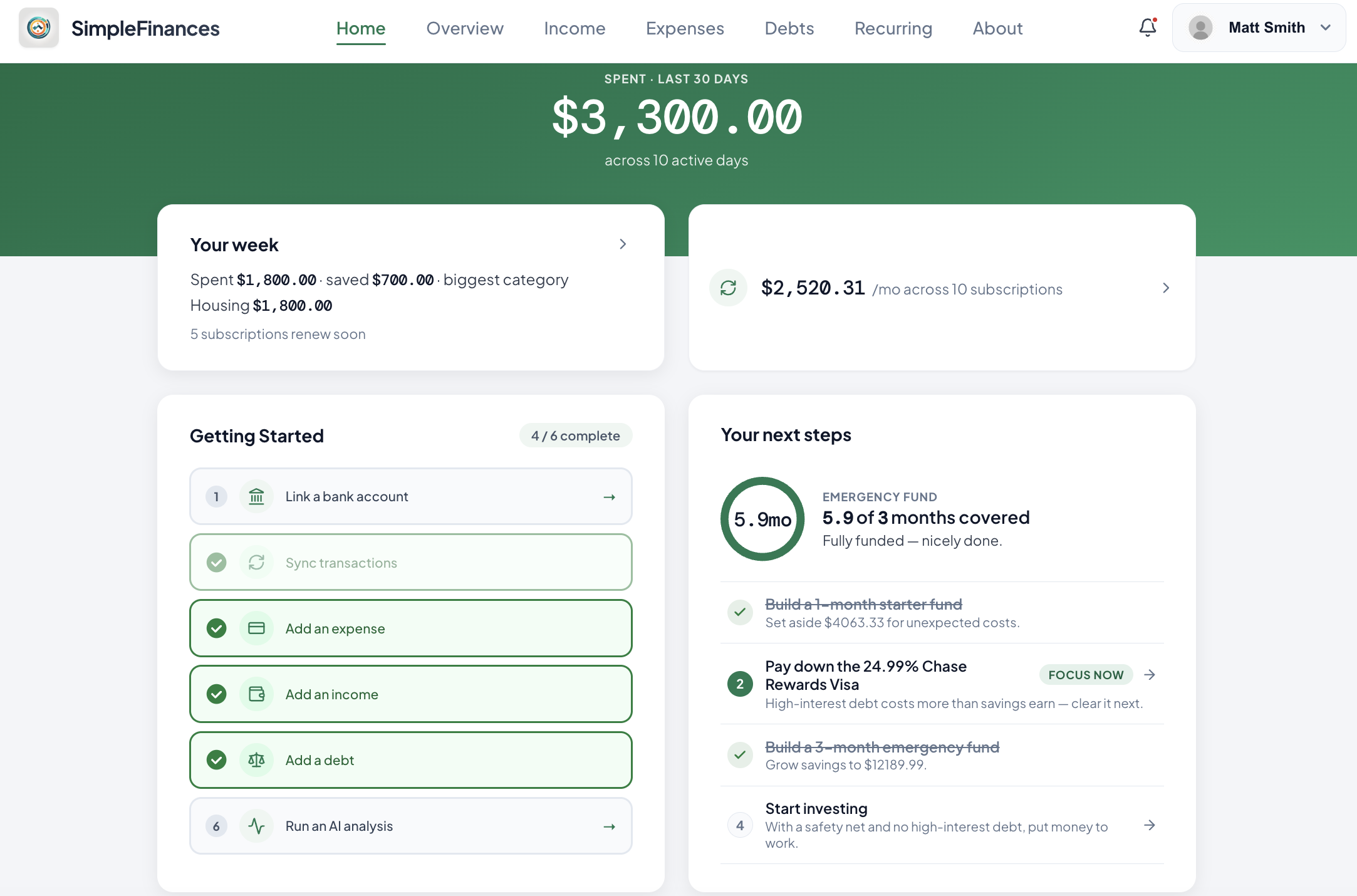
SimpleFinances starts where Credit Karma stops. It's a budgeting-first dashboard: transactions from your connected accounts are categorized automatically, a subscription finder surfaces the recurring charges hiding in your statements, and on top of that sit a financial health score, a net-worth timeline, and a cash-flow calendar: the whole "where is my money and where is it going" picture. It doesn't show your credit score, and it will never recommend you a credit card: there are no ads and no affiliate offers anywhere in the product. Instead of free-with-ads, it charges one printed price: the Full Financial Review is $49.99, one time, not another subscription.
Choose Credit Karma if…
- Free credit-score monitoring is the main thing you want.
- You're working on building or repairing your credit.
- You want fee-free checking with the same login.
- You don't mind card and loan offers in the interface.
Choose SimpleFinances if…
- You want real budgeting: every transaction categorized automatically.
- You want forgotten subscriptions and recurring charges surfaced.
- You want net worth, cash flow, and a health score in one view.
- You'd rather pay once than be shown financial-product ads.
Is Credit Karma really free?
Yes, genuinely. Credit Karma doesn't charge its users anything, and there's no premium tier hiding the good features. The way it works is the way most free financial products work: according to Credit Karma's own "How does Credit Karma work?" page, if you apply for and are approved for a card or loan it recommends, the bank or lender typically pays Credit Karma a small commission. For credit monitoring, that trade is easy to accept. For budgeting, it's worth pausing on: a tool funded by getting you into new credit products has a structurally different incentive than a tool you pay directly. Neither model is wrong. But if you've ever felt like the app was more interested in your next loan than your last month's spending, that's the model, not your imagination. For budgeting specifically, here's what free budgeting apps actually cost you.
SimpleFinances vs Credit Karma: feature comparison
| SimpleFinances | Credit Karma | |
|---|---|---|
| Price | $49.99 one time, no subscription | Free (advertiser-compensated) |
| Credit score & monitoring | No | Yes Its core strength |
| Automatic categorization | Yes | Limited: spending insights, not category budgeting |
| Tells you what to fix first | Yes Full review with next steps | A dashboard you set up and maintain |
| Subscription finder | Yes Included in the review | No |
| Financial health score | Yes Based on your spending & saving | Credit score only |
| Net worth & cash-flow calendar | Yes | Partial: net worth view |
| Ads & product recommendations | None | Card & loan offers (how it's funded) |
| Banking accounts | No | Yes (Credit Karma Money) |
| Bank connections | Plaid, read-only + manual | Read-only |
| Platform | Web: works on any device, nothing to download | iOS, Android, web |
The honest summary: these are different tools for different jobs. Credit Karma is the better pick (and it's free) if credit monitoring is what you're after. SimpleFinances is the better pick if you want a full review of your money and what to fix first, built for people who want to make changes rather than check another dashboard.
Can you use both Credit Karma and SimpleFinances?
Yes, and honestly, it's the setup that makes the most sense for a lot of people, because the two barely overlap. Keep Credit Karma for the job it's best at: watching your credit score, catching changes on your report, and building credit. Use SimpleFinances as your everyday money dashboard: categorized spending, the subscription finder, your net-worth timeline, and the cash-flow calendar. Both tools connect to your accounts through read-only links, so running them side by side doesn't add any risk: neither one can move your money.
Does SimpleFinances show my credit score?
No, and that's a deliberate choice rather than a missing feature. SimpleFinances focuses on the money you actually have and spend: categorized transactions, recurring charges, net worth, cash flow, and a financial health score built from your spending and saving behavior, not your credit file. Credit scores are a solved problem with excellent free tools, and Credit Karma is one of them. If seeing your score every week matters to you, keep Credit Karma for that (it's free) and let a budgeting tool do the budgeting.
How much does SimpleFinances cost?
The Full Financial Review is $49.99, one time. One payment, no subscription. You link every account (banks, cards, loans, investments) read-only, and if a bank will not connect you can drag and drop a statement. You get one complete financial review with every recurring charge found and totaled, 7 days of full Premium access (the subscription finder, health score, net-worth timeline, and cash-flow calendar), and a report that is yours to keep. It carries a 30-day money-back guarantee: full refund, no questions asked. Nothing renews automatically from the $49.99; if you want ongoing tracking afterwards, that is a separate choice you make later, never before. Coming from a free app, the question is fair: why pay at all? The answer is the business model: when you're the customer instead of the advertiser's audience, the product's only job is the one you hired it for. One payment, no ads, no offers, no renewal.
See your actual spending, not another offer
Categorized transactions, forgotten subscriptions surfaced, and a health score, in one Full Financial Review for $49.99 one time. No subscription, no ads, no trial countdown. Start with the free five-question audit.
Start my free money auditSources
- Intuit Credit Karma, "Intuit Credit Karma welcomes all Minters!" (press release, October 31, 2023): creditkarma.com. Source of Mint users being invited to move to Credit Karma.
- Intuit Credit Karma, "How does Credit Karma work?": creditkarma.com. Source of how Credit Karma is paid by banks and lenders. Both pages checked 2026-09-28.
- Monarch, "Pricing": monarch.com/pricing. Source of the Core price ($14.99/mo or $99.99/yr), the Plus price ($199.99/yr, annual only), and the 7-day trial with a payment method required. Checked 2026-09-28.
- CNBC Select, "Mint is gone" alternatives roundup (updated May 13, 2026): cnbc.com. Source of the March 23, 2024 shutdown date; Intuit's own mint.intuit.com now says only that "Mint has been reimagined on Credit Karma." Checked 2026-09-28.